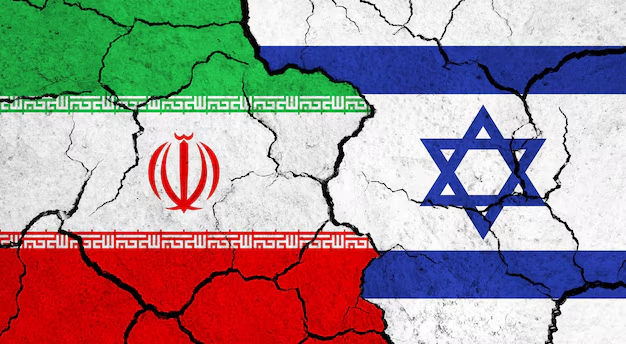
The ongoing conflict between Iran and Israel has once again escalated, capturing global attention in early 2026. This confrontation, rooted in decades of political, ideological, and military tension, carries profound implications not only for the Middle East but also for international security. The recent escalation underscores the fragile balance in the region and highlights the role of the [iran united states] relationship, as Washington plays a critical role in mediating and responding to regional instability. Understanding the dynamics of this conflict is essential to grasp the broader geopolitical consequences.
Historical Background
Relations between Iran and Israel drastically changed following the 1979 Iranian Revolution. Prior to the revolution, Iran maintained relatively cordial diplomatic and economic ties with Israel. However, after the establishment of the Islamic Republic, Iran adopted a staunchly anti-Israel stance, branding the state as illegitimate and positioning itself as a champion of Palestinian resistance.
Over the decades, this hostility manifested in numerous ways: proxy conflicts in Lebanon and Syria, covert intelligence operations, cyberattacks, and occasional direct military confrontations. Cyber warfare, including attacks on critical infrastructure, and intelligence missions targeting military and nuclear facilities have been recurrent tools in the ongoing struggle. The deep ideological divide between Tehran and Jerusalem—combined with competing regional ambitions—has created a persistent state of tension that occasionally flares into open conflict.
Major Causes of the Conflict
Several intertwined factors drive the Iran Israel conflict:
Iran’s Nuclear Program and International Concerns
Iran’s nuclear ambitions have long been a central point of tension. Israel, perceiving a nuclear-armed Iran as an existential threat, has repeatedly warned of potential military action should diplomatic measures fail. International bodies, including the United Nations, have attempted to regulate Iran’s nuclear development, but mistrust remains high on both sides.
Israel’s Security Fears and Defense Strategy
Israel’s military doctrine emphasizes preemptive action and advanced missile defense. With Iran supporting regional proxy groups like Hezbollah and Palestinian factions, Israel maintains constant vigilance to neutralize perceived threats, leading to periodic escalations.
Political and Ideological Differences
The Iranian regime’s anti-Zionist rhetoric contrasts sharply with Israel’s determination to assert its sovereignty. This ideological clash amplifies regional rivalries and complicates potential negotiations.
Influence in the Middle East
Both nations vie for dominance in strategic Middle Eastern regions. Iran’s support for proxy forces in Syria, Lebanon, and Yemen counters Israel’s security objectives, creating continuous friction.
Role of Proxy Groups and Regional Alliances
Proxy conflicts, often involving Hezbollah, Hamas, and other Iranian-backed militias, have served as indirect battlegrounds for Iran–Israel tensions. These alliances amplify hostilities while complicating direct conflict management.
Events Leading to the 2026 Escalation
In the years preceding 2026, tensions steadily increased. Israeli intelligence reported Iranian missile developments, while Tehran accused Israel of targeting nuclear and military facilities. Diplomatic efforts by the [iran united states] channels and European intermediaries failed to bridge mutual distrust. Repeated military exercises, regional confrontations, and aggressive rhetoric set the stage for a larger confrontation.
Beginning of the War in February 2026
Open conflict erupted in late February 2026, following a series of provocative actions by both sides. Israel launched large-scale airstrikes targeting Iranian missile sites, military bases, and key infrastructure. Iran responded with missile attacks on Israeli cities and strategic installations. The rapid escalation reflected years of unresolved tensions and demonstrated the potential for a wider regional conflict.
Military Actions Between Iran and Israel
The military dimension of the conflict involves sophisticated weaponry and strategy:
-
Missile Attacks: Iran deployed long-range missiles targeting Israeli military sites, while Israel retaliated with precision strikes on Iranian positions in Syria and beyond.
-
Drone Warfare: Both nations increasingly used drones for reconnaissance and targeted strikes, adding a modern dimension to the conflict.
-
Airstrikes: Israel’s advanced air force executed coordinated operations to neutralize Iranian-backed threats, while Iran leveraged its missile arsenal to hit critical Israeli targets.
-
Defense Systems: Israel’s Iron Dome and David’s Sling systems intercepted a significant portion of incoming missiles, reducing casualties but not preventing property damage.
-
Retaliation and Strategic Targets: Each side sought to minimize civilian casualties while targeting military infrastructure, though urban areas inevitably suffered collateral damage.
Role of Other Countries
The conflict’s ripple effects extended internationally:
-
The United States: As a key ally of Israel, the U.S. deployed military assets to support defense operations while attempting to mediate through diplomatic channels. The [iran united states] relationship heavily influenced responses, sanctions, and potential intervention strategies.
-
Regional Countries: Nations like Saudi Arabia, Turkey, and the Gulf states monitored the situation closely, with some increasing military readiness and others calling for calm.
-
International Organizations: The United Nations and European Union urged restraint, calling for ceasefires and humanitarian support.
Impact on Civilians and Cities
The war severely affected urban centers:
-
Damage to Infrastructure: Airstrikes and missile attacks disrupted power grids, transportation, and communication networks.
-
Civilian Casualties: Hospitals reported hundreds of casualties and injuries, straining emergency services.
-
Public Fear: Residents faced uncertainty, curfews, and mass evacuations, highlighting the human cost of strategic military operations.
-
Daily Life: Schools closed, markets suffered, and normal economic activity declined sharply.
Economic and Global Impact
The conflict has global economic repercussions:
-
Global Oil Markets: Disruption of shipping routes in the Persian Gulf led to spikes in oil prices, affecting international markets.
-
International Trade: Regional instability slowed trade, particularly in energy-dependent nations.
-
Political Stability in the Middle East: Tensions reinforced alliances and rivalries, influencing policy decisions beyond the immediate conflict zone.
-
Global Economic Concerns: Investors reacted to uncertainty, with potential impacts on global stock markets and commodity prices.
International Reactions
Global leaders expressed concern and sought solutions:
-
Calls for ceasefires and negotiations intensified.
-
Diplomatic channels via the [iran united states] partnership, the UN, and the EU focused on humanitarian aid and conflict mediation.
-
Some countries urged restraint, while others reinforced military readiness to protect their interests.
Current Situation (March 2026)
As of March 2026, the conflict remains active but localized, with sporadic airstrikes, missile launches, and drone activity. Diplomatic efforts continue, with the iran united states dialogue playing a critical role in preventing further escalation. Humanitarian organizations work to assist affected civilians, and global leaders continue to push for a sustainable ceasefire.
Possible Future Outcomes
Several scenarios could unfold:
-
Further Escalation: Continued hostilities could trigger a larger regional war involving additional Middle Eastern countries.
-
Diplomatic Resolution: Negotiations mediated by international powers, including the [iran united states] channels, could lead to a ceasefire and de-escalation.
-
Long-Term Effects: The conflict may reshape regional alliances, alter military strategies, and influence global economic policies for years to come.
Conclusion
The Iran Israel conflict in 2026 highlights the fragile balance of power in the Middle East and the broader implications for global security. The involvement of the iran united states relationship underscores the importance of diplomacy in preventing further escalation. While military strategies continue to dominate headlines, long-term stability depends on dialogue, negotiation, and international cooperation. The world remains watchful, aware that the consequences of this conflict extend far beyond regional borders.





Leave a Reply